What Google announced in June 2026
On 3 June 2026, Google announced dedicated Generative AI performance reports in Search Console for Search and Discover. Google's announcement says the reports show visibility of website URLs in generative AI features such as AI Overviews and AI Mode, alongside related Discover experiences. The new view separates a useful subset from the broader performance picture; it is not an unrelated new ranking algorithm.
The announcement initially described a phased release. If you see a Generative AI report in the left-side Performance navigation, use its exact filters and definitions instead of assuming it measures all AI answer experiences on the internet. Google Search and ChatGPT are different services and a Google report cannot automatically describe recommendations in another product.
Which dimensions are actually described?
Google's launch documentation describes impressions for URLs appearing in covered generative AI features, plus views by page, country and date. Search reporting also includes device breakdowns. It lists time granularity such as hourly, daily, weekly and monthly views. Do not assume every metric or filter from the regular Web Search report is supported identically in this new view.
| Dimension | Useful question | What it cannot establish alone |
|---|---|---|
| Impressions | How often did covered features show a URL? | Actual visits or sales |
| Pages | Which site URLs received visibility? | That every query found them helpful |
| Countries | Where was that visibility observed? | Customer location or qualification |
| Devices (Search) | Which device classes saw pages? | Completed mobile conversations |
| Dates | How did visibility change over time? | The reason for the change |
For exact current definitions, use the help material linked from the official announcement. Do not infer an “AI conversion rate” from impression-only data or give an impression percentage the meaning of guaranteed brand recommendations.
How it differs from standard Search performance
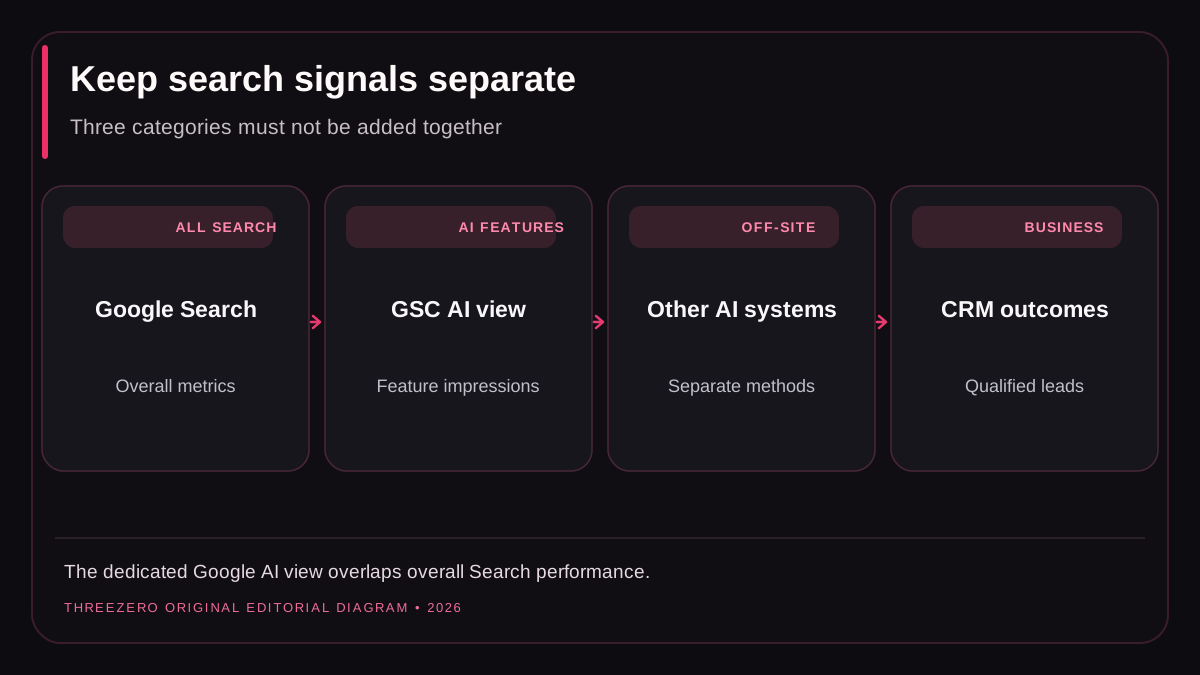
The regular Search Console Performance report can provide clicks, impressions, CTR, average position and query or page views for Google Search under its rules. The dedicated generative AI view focuses on visibility within covered features. The broader report already includes the covered activity; blindly adding the separate report's impressions to the regular total may double-count rather than create a more complete number.
Use different reporting columns with descriptive labels: “Google Search total”, “Generative AI feature visibility”, “Qualified enquiries”, and “Manually sampled AI answers”. They measure different things and may use different methods. Never call a chatbot prompt log “official Search Console data.”
How to interpret ThreeZero's existing snapshot
A user-supplied November 2026 Search Console view for threezero.agency showed a 28-day Web Search total of 350 impressions, three clicks, average CTR around 0.9% and average position 61.4. Those are the standard Web Search figures shown in that view. A separate recommendation card indicated the AEO service page had more impressions than its recent norm. Neither observation tells us how many actual brand mentions occurred in all AI systems.
The screenshot also showed access to the Generative AI report, but did not include that report's own numerical breakdown. Therefore this article does not invent an AI-feature impression total or claim a ranking improvement from new blogs. The GSC diagnostic explains how to avoid overinterpreting a small overall dataset.
Build a disciplined monthly review
- Record the report name, property, search type, exact date range and any country filters.
- Export URL-level dimensions where available and keep them separate from general Web Search.
- Annotate page changes, deployments and new publications, but do not treat correlation as causation.
- Use the same reporting windows when comparing periods.
- Keep a record of query intent and relevant pages from regular Search performance.
- Separately verify contact form success, calls and CRM-qualified enquiries.
- Document missing metrics and uncertainty rather than filling gaps with estimates.
Google's AI features guide explains that ordinary SEO foundations remain relevant and that special markup is not required. Good page content, accessibility, trusted business details and useful internal links are still the right priorities.
Three mistakes to avoid
Adding two reports together. Google says the generative AI view describes activity also included in overall performance. Maintain separate views, not a synthetic sum.
Calling an impression a ChatGPT recommendation. A Google feature impression is not a verified ChatGPT answer, nor is it a confirmed lead.
Claiming instant causality. A new article and a higher impression count in the same week do not prove the publication caused the change. Check page-level data, relevance and sufficient periods first. For a measurement strategy, read how to measure AI visibility or visit AEO services.