Why the Business Profile and website do different jobs
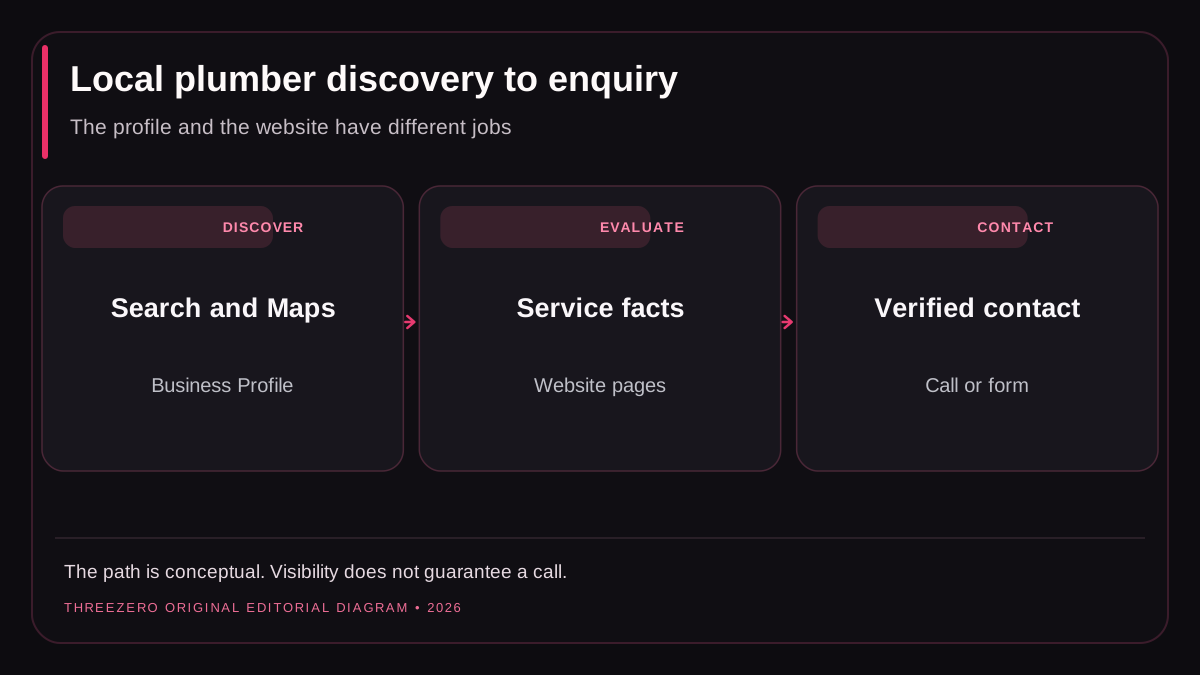
A Google Business Profile is designed to help eligible businesses share information through Search and Maps. It can provide a working phone number, business category, hours, location details and customer feedback. Your website provides the detailed explanation a homeowner needs to decide whether to call: which plumbing jobs you handle, what an appointment involves, what areas you actually serve and what the next step looks like.
Google says local results are mainly influenced by relevance, distance and prominence, not an agency's ability to buy a better organic position. The official local ranking guide is a more reliable starting point than a promise to put every plumber at number one.
Set up a legitimate service-area Business Profile
Plumbers commonly work at customer addresses rather than inviting customers to a staffed public office. If you operate from a residential address and do not serve customers there, Google's guidance says to hide that address from public view and specify your genuine service area. Do not use an unstaffed virtual office as if it were a physical branch. Separate Business Profiles for actual independently staffed locations are different from creating dozens of fictional town offices.
Represent the real business name, not a string of nearby city keywords. Choose accurate available categories and business hours, list the actual services and keep the phone number under your control. If you say you offer 24-hour emergency repairs, you should have a realistic plan for answering and dispatching calls during those hours. Google's business representation guidelines and address rules spell out these requirements.
- Use your legal or genuine public-facing business identity consistently.
- Confirm service coverage, holidays and exceptional closing hours.
- Post permissioned photographs of real equipment and work instead of fabricated before-and-after images.
- Request voluntary honest reviews from genuine customers, without incentives or scripting a five-star result.
- Correct wrong listings that send customers to a disconnected number.
Make the plumbing website useful within the first screen
A visitor with a burst pipe is unlikely to study a long brand story first. They need the specific service, service area, actual response conditions and a reliable phone link. A headline like “Drain cleaning, leak repair and water heater installation for homes in our listed service area” is more useful than “Trusted plumbing excellence.” This is illustrative copy, not a verified description of any named plumbing company.
Dedicated pages are justified when the service requires distinct explanations. Drain cleaning may involve signs of blockage, what equipment technicians use and when a camera inspection is relevant. Water heater installation may need separate details about gas or electric models, disposal, permits and what affects a quote. Do not describe certifications, guarantees or emergency availability you cannot substantiate.
The contact path must work on a phone: readable links, appropriately sized buttons, a validated form, a visible error state and actual submission confirmation. A phone-link tap is not the same as an answered call. Read how to track calls, WhatsApp and form leads without inflating those metrics.
Service pages versus location pages
Not every town in a service radius needs a separate page. A strong coverage page can describe the actual working area and which services are offered throughout it. Distinct location pages become useful when a real staffed operation, process, customer concern, local constraint or proof makes them meaningfully different.
Google's doorway abuse policy warns about many similar pages targeting city variations and funnelling visitors to one generic destination. Replacing “plumber in Dallas” with “plumber in Plano” without local substance does not improve the customer experience. Our service-area pages guide provides a practical decision test.
A hypothetical audit, with separate responsibilities
Imagine a fictional contractor whose profile lists general plumbing but whose site only says “quality services.” A focused improvement would verify real service categories and hours, explain the actual repair types, photograph jobs with permission, and test calls and forms. It would not create new fake branches or claim that AI recommendations are guaranteed.
| Customer question | Business Profile role | Website role |
|---|---|---|
| Are you actually nearby? | Legitimate location and service area | Coverage explanation |
| Do you handle this repair? | Accurate service labels | Detailed service page |
| Can I contact you today? | Correct hours and phone | Availability terms and contact flow |
| Can I trust your work? | Genuine customer reviews | Permissioned work examples |
This table explains the relationship, not a ranking formula. The website should have direct links to the profile where appropriate, and the Business Profile website field should point to the correct business site.
Track local SEO as a business activity
Review the site's organic landing pages and query trends in Google Search Console. Compare Google Business Profile interactions separately, then reconcile with call records, qualified estimates and booked work. Local demand can change with weather, emergencies or competition; do not attribute every fluctuation to one title edit or blog post.
Useful weekly questions include: Which services produced real enquiries? Were calls answered? Did the customer live in the service area? How many estimates became jobs? One verified booked job can be more relevant than a rise in generic impressions. For help with technical SEO, see ThreeZero SEO services or request a scoped review.