Which real page and code changes are being reviewed?
This is a first-party engineering walkthrough of the ThreeZero AEO service page and related rendering code. The source is the public repository's earlier state and the changes merged through Phase 2 pull request #106. The purpose is to show how a technical and content problem was identified, how the implementation addressed it and what still requires production verification.
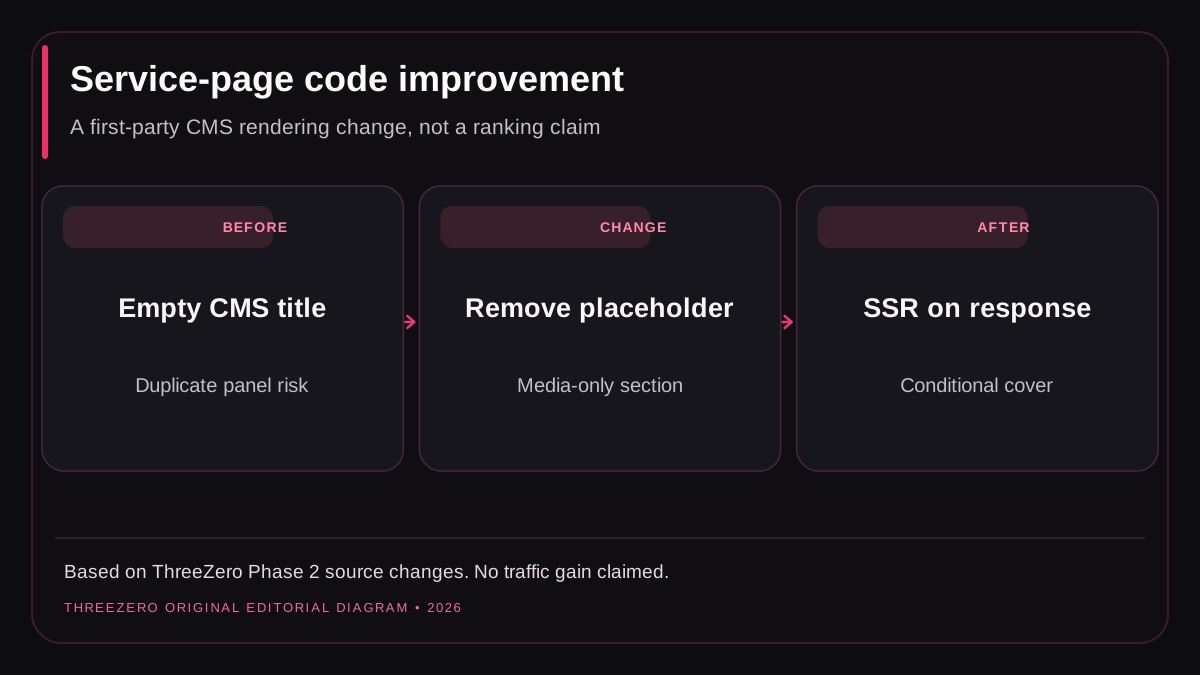
Before the change, the AEO page contained a hidden CMS section with a “FROM THE SERVICE LIBRARY” eyebrow plus an empty title and description placeholder. In a dynamic path this created the possibility of a redundant or empty content panel becoming visible after the page loaded. The main service introduction already explained the offering, so another empty section was not useful information for customers or crawlers.
Before: what could go wrong with empty CMS placeholders?
Publishing a service page with a duplicate content holder is a quality issue even when the section is initially hidden. If the client hydrator opens it without meaningful data, visitors may see a heading with no explanation, a sudden spacing shift or a second copy of the original headline. Unstable first paint can also create a confusing experience when a homepage or service title briefly changes after JavaScript starts.
It is important not to overstate the finding: an empty hidden heading in source code does not automatically create a Google penalty. The observable problem is the unnecessary UI and risk of content instability. Google's AI search guidance favors accessible, useful content but does not identify this particular bug as an AI-specific ranking factor.
After: render meaningful content at first response
The updated template removes the empty duplicate heading and description. An optional visual section stays hidden unless there is an approved service image. The server-side renderer only emits valid media URLs from the application's own uploads path, and uses reserved dimensions and lazy loading on the optional cover. The intent is to avoid an empty visual box and unnecessary content movement.
The broader Phase 2 work also avoids redundant CMS re-fetch and repainting on pages already carrying server-rendered, authoritative content, while retaining a fallback for pages served as static HTML. For this site, the server uses the published service record and the managed page renderer to construct the initial response. Changes to actual SEO metadata are handled by its server-side SEO renderer rather than relying on a later browser-only update.
Before (simplified concept):
section + optional title + optional description + cover
if CMS values are missing: risk of empty second heading

After (simplified concept):
main service heading and description remain in the hero
optional cover section is hidden unless valid media exists
server emits the relevant HTML before client hydration
This is explanatory pseudocode, not a verbatim diff. The linked pull request contains the authoritative implementation, tests and changed files.
Why the fix is useful beyond an “AEO score”
Better first-response content helps ordinary users, search crawlers and accessibility testing tools operate on the same page information. Avoiding a visually empty CMS panel makes the interface easier to scan. Restricting a media URL to the application's intended file path also avoids unexpectedly treating a third-party tracking URL as an official service image.
None of these choices can guarantee a citation in an AI Overview or a ChatGPT recommendation. Google says that AI features use the same basic search foundations and require no special schema. A safer engineering conclusion is that the page content and rendering became more predictable, not that the site acquired an “AI ranking boost.”
How we checked behavior, and what the checks do not measure
Phase 2 introduced Node regression checks for the service templates and a Chromium responsive smoke-test workflow. The repository's Phase 3 browser QA later reported 104 passing responsive checks with no failures on its validated run, covering homepage interaction and key service layouts across 320, 375, 390, 430, 768, 1024 and 1440-pixel viewport widths.
Those checks support assertions about intended navigation, layout, missing headings and other tested UI behavior. They do not provide production Largest Contentful Paint, Interaction to Next Paint, Core Web Vitals field data, ranking improvements or new leads. A local browser test is not a real-user performance report. Production server routing and the contact inbox must also be verified separately.
| Claim | Evidence | Limit |
|---|---|---|
| Empty heading removed | Committed service template change | Does not prove more clicks |
| Optional media rendered conditionally | Server renderer and regression test | Asset delivery needs live check |
| Responsive flows tested | Chromium smoke workflow | Not Core Web Vitals field data |
| Search ranking improved | No controlled evidence | Not claimed |
Replicate the audit on your own service page
- Inspect the HTTP response rather than only the final hydrated browser DOM.
- Compare the visible page with its CMS record and intended canonical URL.
- Find duplicated or empty headings, placeholder cards and hidden sections opened after load.
- Validate that images come from permitted sources and have intrinsic dimensions.
- Test mobile navigation, keyboard focus, a valid CTA, unknown routes and error states.
- Confirm the actual form provider accepts and delivers submissions.
- Capture a Search Console baseline, but keep rankings and impressions separate from implementation claims.
Google's helpful-content guidance asks whether a page provides useful original value. A page audit should answer that for a visitor, not only for a crawler. To scope a technical review, see AEO services, website development and the contact page.